Florida Pool Fence Requirements: Barrier Code Explained
The 48-inch rule, the 4-inch sphere test, climbability, gate hardware, and the three things that fail Ocala pool barrier inspections most often.
Get a written fence quote
Reading up before you buy? Get a real number for your property.
- No obligation
- Permits handled
- Licensed & insured
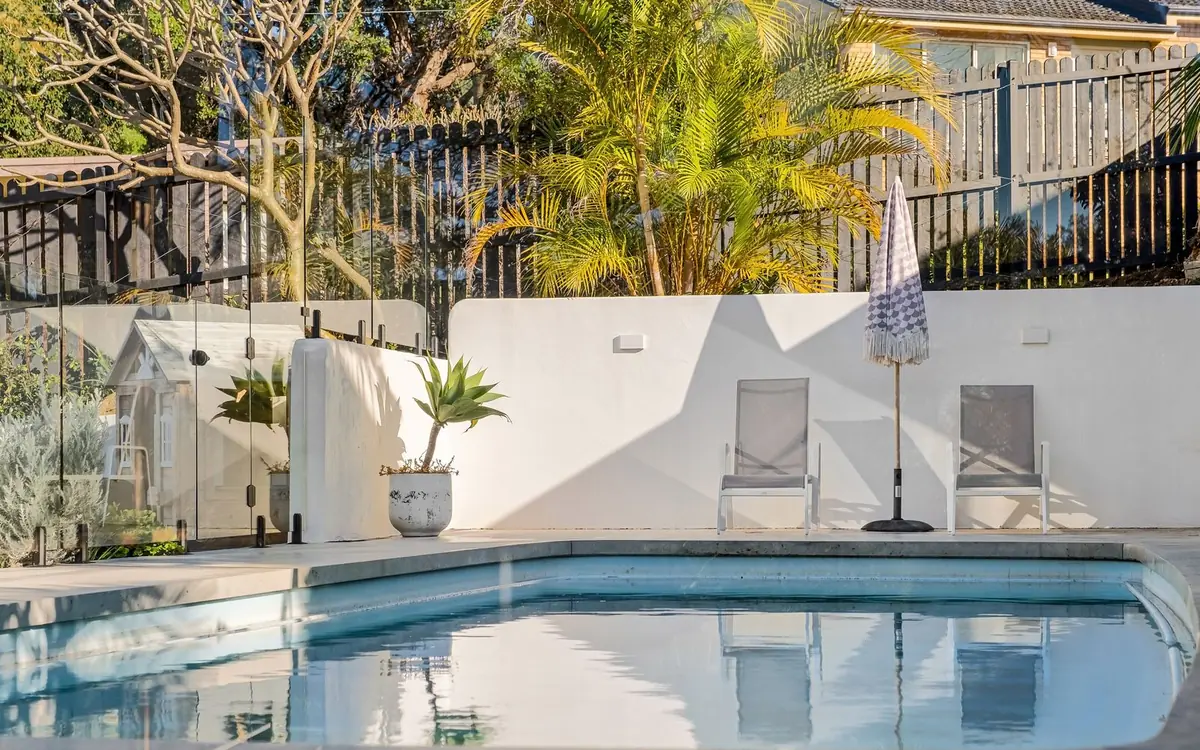
A pool fence in Florida is not a design choice, it is a legal requirement under the Florida Residential Swimming Pool Safety Act, and it is one of the few fences that actually gets inspected. A barrier that misses any single requirement fails, and more importantly it leaves a real gap in child safety.
The core requirements
48in minimum height · no gap over 4in anywhere · no external climbable surfaces between 4in and 45in · gates self-closing, self-latching, opening away from the pool · latch positioned per code on the pool side.
Height: 48 inches, measured correctly
The barrier must be at least 48 inches high measured on the outside face, from finished grade. That last part catches people out on sloped Ocala lots. A 48in fence at the high side of the yard can measure 52in on the low side, which is fine, but a fence set on a berm can measure less than 48in from the outside ground level and fail.
The 4-inch rules
- No opening in the barrier may allow a 4-inch sphere to pass through. This governs picket spacing on aluminum and ornamental fence.
- The gap between the bottom of the barrier and grade must not exceed 2 inches on a solid surface, or 4 inches over grass or earth depending on the specific configuration.
- On sloped or eroded ground this gap is the single most common failure we find on existing Ocala barriers. Sand washes out under a fence line and creates a gap that did not exist at install.
Climbability
The outside of the barrier cannot offer handholds or footholds between roughly 4in and 45in above grade. In practice this rules out:
- Horizontal rails on the outside face, which is why chain link and ranch rail are poor pool barrier choices.
- Lattice or decorative elements that create a ladder effect.
- Anything placed near the fence: AC units, pool equipment, planters, garden benches, firewood stacks. The inspector will look at what is beside the fence, not just the fence.
This is why powder-coated aluminum in a flat-top or spear-top configuration has become the default pool barrier in Marion County. The pickets are vertical and the rails sit where they do not help a child climb.
Gates: where most barriers fail
Gate hardware causes more inspection failures than the fence itself. A compliant pool gate must:
- Be self-closing from any open position, including fully open.
- Be self-latching, latching reliably every time without being pushed.
- Open outward, away from the pool.
- Have the release mechanism positioned per code on the pool side, high enough that a small child cannot reach it.
- Remain latched under normal wind and use. A dragging or sagging gate will not self-latch, which is why gate bracing matters here more than anywhere else.
Spring hinges lose tension over time. If your gate used to close on its own and now needs a push, the barrier is non-compliant today even though it passed years ago.
Does a screen enclosure count?
A screened lanai can satisfy the barrier requirement, but only if it fully surrounds the pool and every door into it meets the self-closing self-latching standard. Many Ocala and Summerfield lanais fail purely on door hardware. Correcting that is usually a cheap fix compared with building a new barrier, and it is worth having checked rather than assumed.
Doors from the house
Where a wall of the home forms part of the barrier, additional protection is required on doors leading to the pool, typically an alarm or a self-closing self-latching door with the release at the specified height. This catches homeowners who fence three sides and rely on the house for the fourth.
What to do if yours was flagged
A home inspector or insurer flagging your barrier does not automatically mean replacement. In most cases the failures are gate hardware, a gap under the fence, or a climbable object sitting next to it. We survey the barrier, list what fails and quote only the corrections. Details on the pool fence page, or see fence repair if the fence itself is damaged.
This article summarises the general requirements and is not a substitute for the current Florida Building Code or your local authority's interpretation. Requirements are enforced by the City of Ocala or Marion County depending on your address.
Read the rules yourself in Florida pool safety statute (Chapter 515) and on the Florida Building Commission site. Marion County inspection steps are on the county permitting FAQs.
Common questions
How high does a pool fence have to be in Florida?
48 inches minimum, measured from finished grade on the outside face of the barrier. Local jurisdictions can require more, so the height is confirmed against City of Ocala or Marion County requirements at permit review.
Can I use my existing privacy fence as a pool barrier?
Often yes, if it is at least 48in, has no gaps over the limit at the bottom or between boards, and every gate into the pool area is self-closing and self-latching with the release positioned correctly. Gate hardware and bottom gaps are the usual failure points.
Do pool fence gates have to open outward?
Yes. A compliant pool gate must swing away from the pool, and it must self-close and self-latch from any open position including fully open.
Does a chain link fence meet Florida pool code?
Usually not without modification. The mesh itself is climbable and standard configurations have horizontal top and bottom rails on the outside face. Aluminum, vinyl and removable mesh systems are the practical compliant options.
Related pages
Pool Fence
A pool fence in Florida is not a design decision, it is a code requirement, and it is the one fence that gets inspected.
See the page →Aluminum Fence
Aluminum gives you the look of wrought iron with none of the rust, which in a climate with daily summer rain and irrigation spray is the entire argument.
See the page →Gates & Openers
The gate is the part of the fence you actually touch every day, and it is the part that fails first when it is built wrong.
See the page →More from the blog
Fence Installation Cost in Ocala, FL: 2026 Price Per Foot Guide
Real per-foot pricing for every fence material in Marion County, what drives the number up, and the five line items a cheap quote quietly leaves out.
Read →Do I Need a Fence Permit in Florida? Ocala & Marion County
Height limits, setbacks, corner-lot sight triangles, HOA approval and what happens if you build without a permit in Marion County.
Read →Best Horse Fence for Ocala Pasture: Safety, Cost & Lifespan
Board, no-climb wire, vinyl rail and flexible rail compared on injury risk, cost per foot and how they hold up on Marion County sand.
Read →Wood vs Vinyl Fence in Florida: The 10-Year Cost Comparison
Vinyl costs 30 to 50 percent more on day one. Here is the year it overtakes wood on total cost, and when wood is still the right answer.
Read →Ocala & Marion County
Get a written price on your fence
Free on-site measure anywhere in our service area. We list post depth, spacing, gate hardware and who pulls the permit, so you can compare quotes on the same terms.
Previous: Do I Need a Fence Permit in Florida? Ocala & Marion County
Next: Best Horse Fence for Ocala Pasture: Safety, Cost & Lifespan
Free estimate
Same business day callback during office hours.
Free on-site measure
Get a real number, not a phone guess
We come out, measure the run, check the grade and the soil, and hand you a written price. If a repair is the smarter spend, we will say so.